My First NAMM – January 1997

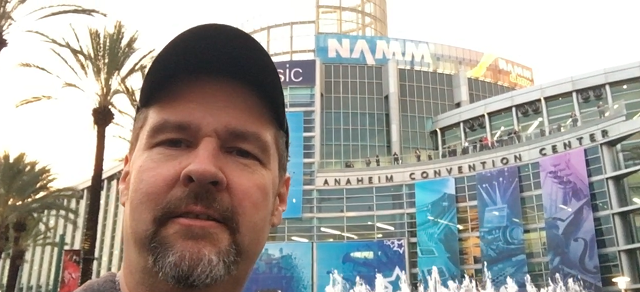
Seer Systems RealityMy first NAMM experience was in the Winter of 1997 and I got to see Seer Reality, and a lot of other great new software products on the floor.  1997 was a great year for computer software:  Personal Computer Music software was booming, driven by the mass availability of high quality audio cards, cheap CD burning, and improvements in computer speeds.  Most of what you could do in analog recording was now possible with an inexpensive PC, and it was faster and easier.  Being able to see the latest technology in those days was amazing.  I have been to NAMM several times since, but I have not seen as dramatic a change in music production tools since that first show.

I have been recording music for quite a while.  First, with a pair of cassette recorders in the 70’s, then with a cassette-based 4-track in the 80’s, then with a SVHS-based 8-track in the 90’s, and now with computers.  One of the pivotal moments along that path came at NAMM in January of 1997, when Seer systems released the first professional software synthesizer for the PC called “Reality”.

To be sure, sampling software synthesizers had been around on dedicated devices since the late 70’s from companies like Synclavier and Fairlight.  On those systems, the software filled a role more like an operating system – commanding all the resources of the device with a guaranteed slice of CPU, rather than sharing the hardware with many other processes that could steal time slices away with no warning.  Dedicated hardware is expensive, with the early samplers costing more than $25,000.  The introduction of a professional quality synthesizer for the PC opened the door to great sounding instruments for everybody.

Reality was kind of a hybrid between the Windows Platform and a dedicated hardware platform.  Seer only runs on Windows 95 and 98 because it needs access to some hardware-level functionality that is not allowed on the later versions of Windows.  That functionality guaranteed Reality the responsiveness it needed to deliver a professional playback experience in real time.  Once Reality proved it could be done, a whole array of other software synthesizer products began to pop up.

Computer power had increased dramatically since 1997, and is now generally capable of powering a software synthesizer without having to reach down into the hardware level to make that happen.


Posted in Music Business | Leave a comment

Music Software in the Connected Age

It seems like most of the obvious problems in Music software have been solved, so you might think “audio is done” and there is no room to grow a business in music software today.  But I believe there is a very clear field for growth in the Music software industry that mirrors what occurred in the automobile industry in the 1970’s.

At that point in time, the American automobile market was saturated with automobiles. Henry Ford’s dream seemed to be fully realized. But marketing luminaries at the time recognized that the system of mass production tended to fall short in some way in terms of providing what people wanted most. Mass production is great when everybody wants the same thing, but we don’t all want the same thing from a car – or from music software. A gap between what mass production can provide and what the market wants is a business opportunity waiting to be tapped! But in the case of Music software, I believe there is an even bigger opportunity waiting thanks to the internet…

Beyond just creating software that zeroes in on the needs of a particular class of musician, there is the opportunity to use the internet to facilitate connecting groups with different strengths. Imagine there are two musicians: Jane, and John. Jane is really interested in composing loops, while John loves to finesse loops into a really tight beat. If Jane had a piece of software that focused on creating great loops efficiently, she could make more loops, or she could make the same amount of loops of higher quality.

Now if there was an easy way for Jane to sell her loops to John, or for John to put out a request for some new loops to Jane, Jane could sell more and better loops to John. With more and better loops, John can make more and better beats, and maybe make more money off of his passion. This is already being done to some degree by sites like BeatPort and BroadJam, but there are many links in the music chain left to connect.  And the best part is that music software that is targeted to specific modes of music production can ultimately provide better music for everyone!

If you are interested in a more in-depth explanation of the power of specialization, take a look at this video.

Posted in Music Business | Leave a comment

Why I Started nuVibrations LLC

Back in the mid-1990’s I was part of a game software startup called “SolidState”.  We were lucky enough to land a deal with NEC Japan to produce a game called “Dark Fiber”, a cyber-punk adventure based on a souped-up Myst QuickTime VR-like engine.   We spent two years of hard work to create our game.  When it came out, there were something like 2,000 other game companies vying for 200 shelf spaces in software stores that year.  Needless to say, our 5 person company had a hard time competing, and we were ultimately unable to obtain a US distribution deal, and never saw a penny of royalties as a result.  But it was a wonderful learning experience nonetheless.

One of the important things I learned was that all the game companies I was aware of were using a small set of audio tools to create those games.  I also learned I had a passion for designing and optimizing game engines – especially audio DSP engines.  With those two lessons learned, I concluded that the place for me was in the audio software business.  It wasn’t very long before I was working at one of those companies:  Passport Designs, one of the first developers of MIDI software on the PC.

The audio software business has grown up since then, and a lot of the obvious problems in the area of audio software have been solved.  But then too, the number of people using audio software has grown and changed.  Back in the “good old days”, only the most die-hard audio professionals were using audio software.  But as great audio software and hardware got better and less expensive and computers found themselves on almost every desk or lap (or now palm) in America, a new breed of customer came into existence: The consumer-hobbyist.

As those hobbyists came online, many current sound designers found employment creating content for the hobbyists to use.  This is what has happened with loop-based media used by programs like Acid or ReCycle:  Growth in the customer base has created more jobs for people like me whose passion is to produce audio tools and media.  This trend is continuing today and can be seen in the wide array of apps available for handheld platforms.  The bottom line is that making music software more accessible gives more people the ability to tap into their innate desire to make music.

That is an absolute good – worthy of dedicating my blood, sweat, and tears to.  So here I am!

Next time, I plan to write on the topic of how creating ways for people to specialize in an audio production  field will actually improve music for everyone, so subscribe to my RSS feed now!

Posted in Music Business, nuStatus | Leave a comment

Thinking About Kickstarter?

If you have been engaged in social media recently you have probably been hearing about a website called Kickstarter where people pitch ideas and get funding from other people online.  Maybe you have even got a project in mind that you would like to get funded.  Just under 50% of Kickstarter campaigns end up getting funded, so it is important to maximize your chances of success, or at least know when you have a good chance of success before you commit.    What follows are the top three takeaways from a recent seminar hosted by a successful Kickstarter entrepreneur.

Know that there is a potential downside and plan to minimize the risks.

If your Kickstarter campaign fails there is a downside that can extend beyond not getting your project funded.  A poor campaign can make you look bad to your existing followers and kill off whatever momentum you have developed in your venture.  So do your homework and make sure your idea has a good shot before you put your sweat and blood into it.  Check out Kickstarter projects like yours and see what has succeeded and what has not, and try to determine why.

Be creative and responsive with your giveaways.

While you may be most focused on the thing you are trying to get funded, there is all the other stuff that will multiply the effectiveness of your campaign – the giveaways for various pledge levels.  If you are making a music CD, you have got to offer more than just a free copy of the CD.  You could provide a signed copy of the CD with a bonus DVD showing the band in the studio.  Maybe you could offer free tickets to your concerts, or even a free live in-home performance.  But you have to think even larger than that.  You could partner with other people looking for publicity and multiply the value you can offer.   Of course, you need to tap into all your options (like e-mail lists, facebook, linked-in, etc) to broadcast your giveaways.

And don’t think you are done creating giveaways as soon as your campaign kicks off!  You can and should add new offers all through your campaign.  Maybe you can hold back on a few offers early on and post them later.  Maybe you can create an entirely new offer during the process.  But be careful what you offer!  Once somebody makes a pledge for a specific offer, you can’t remove it and you are committed.  Make sure the pledge more that covers the cost of the offer – including any potential shipping costs to remote corners of the earth.  If an offer isn’t drawing any attention, get rid of it!  A bad offer can distract people from finding a more appealing offer.  No matter how valuable you think an offer is, if it isn’t generating pledges, it needs to be removed.

Think beyond your Kickstarter campaign.

Whether your Kickstarter campaign succeeds or fails, there are longer term opportunities you should keep in mind. Evaluate your long term goals and make sure those get addressed in your campaign.  Would building your e-mail list help?  If so, you should find a way to get people to sign up for your list while your campaign is active.  Are there any relationships you would like to build?  If so, you should try to find a way to use your campaign to build them.  You could get a lot of attention from your Kickstarter campaign, and it would be a shame to waste that opportunity.

Good luck!

If you have done your homework, been creative, and aligned your campaign with your long term goals you stand a good chance of having a successful Kickstarter project that could launch your venture into a brighter future.  Kickstarter is an exciting development in funding, and I hope I have helped you maximize your chances of prospering from it!

Posted in Music Business | Tagged | Leave a comment

Fresh Sounds From nuSpin!

Last week I put out an update for the nuSpin VST instrument beta testers that included the addition of a second per-note filter among other goodies.  The next day, I had an email waiting in my box with a great audio clip attached that highlights what is now possible. Everything but the drums is nuSpin:


If you listen closely to the bass line, you can hear the two-filter setup operating on what sounds like a sawtooth wave.  It is great to see people apply their creativity using the tools I have constructed; this is exactly why I chose to get into the business of writing audio software, and I hope to hear a lot more as the nuSpin virtual instrument finds its way into the hands of more sound designers in the near future.

I have been sensing that the synth is getting close to ready because I have been finding it more difficult to resist playing with it myself.  As I was testing the two-filter design a couple weeks ago, I discovered one of the tricks I have heard in a lot of dubstep music played on filth.fm:  By using a sawtooth wave and modulating the frequency of two parallel band-shelf filters in opposite directions, you can get something that sounds like a robot saying “yoy”. That discovery probably cost me an hour of development time! :)

Step by step, I am getting closer to living up to the motto of nuVibrations LLC: Software Helping Artists Stay Fresh.

Posted in nuStatus | Tagged | Leave a comment

About Doubt

I started nuVibrations in November of 2010.  Since that time I have been hard at work developing my VST instrument plug-in.  It is getting quite powerful now since I added an array of filters and effects to help shape the sounds.  But every once in a while I have a day where I find I am questioning my decision to invest so much of my time and money into my soft synth.

I have come to realize that these periods of doubt are generally good for me.  They make me step back and re-evaluate my decisions.  Usually I come to the conclusion that I am on the right path.  Once in a while my doubt days motivate me to come up with a slight change in plan that improves my prospects for success.  Today, I am motivated to write a blog exploring the role doubt plays in creating successful outcomes.

What I have noticed about successful people is that most have mastered the ability to engage in seemingly contradictory behaviors.  The behavior they exhibit at any given time is based on the situation rather than on habit. In the case of my doubts, its opposite is my sense of certainty.  When is certainty appropriate, and when are doubts called for?  It depends on the goal.

Certainty is great for creating momentum.  The more certain I am, the faster I can proceed with a project because I can focus entirely on getting the job done rather than questioning if the job is worth doing.  This suggests that the optimal time to engage in doubt is at the beginning of a development cycle and when something significant to the original decision changes.  And when have I had enough doubt?  The time for doubt is over when I have come up with a plan of action that has a well-defined purpose and enough specificity to bring me to the desired results.

My doubt days usually start with a piece of information coming to my attention that I had not been aware of previously.   Since that is one of my criteria for engaging in doubt, I seem to be on the right track.  But just to be safe, then next time I am feeling a sense of doubt, the first thing I plan to ask myself is:  Has something significant to my original decision changed?  If so, I will spend a little time evaluating the situation.  If not, I am going to switch back to confidence mode.

Posted in nuStatus | Tagged , | Leave a comment

How to Produce a Great Album

One of the strategies for achieving excellence I learned at the 2010 IMMMS was “Aim Low,  Get High”.  Great things are built in small steps that incrementally make the result great.    The key to success is having the tenacity to keep building until you are there and a sense of taste that allows you to realize the next steps you need to take.  This approach works for all kinds of creative endeavors from music to theoretical physics.  So let’s assume you have mastered your instrument and take it from there…

Popular culture portrays creativity as if a creative genius gets a great idea all at once.   But that is absolutely not the case.  I used to work with Douglas “Spot” Spotted Eagle at Sonic Foundry.  One day while I was at the gym pumping iron in front of the TV, I saw Spot win a Grammy Award.  I later asked him where he found the time to put out that great album while working at Sonic Foundry.  He chuckled and told me it took years to get to that point.

If you are going to spend years on a project, you need to have an idea of where to go next at every stage if you are going to succeed.  How do you do that?  You have to develop a sense of taste, and that usually requires immersing yourself in the existing body of work in your chosen domain.  When you do that, you will inevitably begin to develop a catalog of the work you like best.  And once you have that catalog you should ask yourself what it is that makes those works stand out for you.  By doing that you develop your inner compass that will help point you in the direction to greatness.

Albert Einstein was once asked how he thought differently than most people.  Einstein’s answer was that most people, when given the task to find a needle in a haystack dig through the haystack until they find the first needle.  But Einstein suggested he would dig through the entire haystack until he found all the needles.  That kind of tenacity is exactly what it takes for greatness!

Can musicians apply this kind of tenacity to produce a great album?  Yes they can!  Say your goal is put out an album with 10 great songs.   You could just write 10 songs and put them all on the album.   But what if you wrote 20 songs instead and picked the best 10 out of those songs?  Chances are you would end up with a much better result if you did.  This concept can be applied at multiple levels of songwriting too:  Try a few variations of melodies, chord progressions, lyrics, or instrumentation and see how it impacts your results!

So stick with it, and learn what you love about the music you like!

Posted in Music Business | Leave a comment

Knobs Versus Faders

I am in the early stages of getting beta tester feedback on the VST Instrument plug-in I am creating.  One of my testers this weekend expressed a preference for faders (I chose knobs) in my plug-in’s user interface.  That got me to reassess the situations when knobs and faders might be most appropriate.

The fundamental property that both knobs and faders afford is allowing the user to use an offset of a control to represent a value.  In the case of the knob, the offset is an angle, and for the fader it is a horizontal or vertical position. Adding precision for a knob means a larger diameter to afford showing more of a visual change for the same amount of angular offset.  Adding precision for a fader means a taller or longer fader to show more pixels of change for a given amount of value change.

The big drawback with a knob is that is does not provide the most intuitive mapping between how the knob turns and how the mouse needs to move to control the knob.   The two popular methods are to have the knob point toward the mouse, and to have a linear mouse motion turn the knob.  The first method is not as precise, but the second feels a bit disconnected.

The big drawback with a fader is that it needs a lot of screen real estate in order to provide that same level of visual precision as a knob.  Let’s say you have a 64×64 pixel knob.  A full rotation of that knob provides 201 pixels of rotation around its circumference.  Most knobs are limited in range to provide some space for labels, so say 15% of the space is taken away for that, you are left with about 170 pixels of space to rotate.  In order to provide a fader with the same amount of visual precision, you would need a fader that was 170 pixels wide (plus the thumb width and any padding).

The bottom line: Faders are more intuitive but if there is an advantage to working with a smaller amount of space a knob might be a better choice.

Posted in Uncategorized | Leave a comment

How much music production will be done on the iPad?

As a developer of computer music technology, I have a keen interest in identifying the greatest opportunities in the future of computer music.  Will everyone move to the iPad?  Or maybe the iPad will be a passing fancy?  I suspect the answer will lie somewhere in between.

People are getting more creative about finding ways to maximize their productive time compared to 20 years ago.  Cell technology now allows for people to communicate in any location with cell service.  If someone is going to be late to a meeting, they can now call ahead and inform the people in the meeting and make alternative plans.  If you head out to the grocery store and your significant other realizes there is something else they needed you to get, they can now call you and update your shopping list.  If you are lost, you can connect to the Internet on your mobile device and view a map of your current location.

But what about music?  Unlike simple communication, making music consumes more of your attention, so it isn’t quite suited to the range of environments that people are using for cell phone communication.  Headphones can certainly improve your listening experience wherever you are, but many mobile devices can’t be seen in bright sunlight.  The smaller screens (1024×768) are limiting compared to most desktops, so apps tend to focus on a narrower set of tasks (which can be a good thing).  A touchscreen is certainly better than a mouse, but the lack of a keyboard means accelerator key options are limited.

The bottom line is that iPad apps that can work with a narrow focus will be done more on the iPad, while apps with a broad range of options, or that are greatly enhanced by keyboard accelerators are going to stay on the traditional desktop or laptop.  It is also a safe bet that developers will be providing better and better interoperability between iPads and traditional desktops, so that you can fly out a simple task to your iPad while riding the train to work, then re-integrate your work into a larger project on your desktop once you get there.  For that reason, I suspect music production on laptops and desktops isn’t going to disappear and iPad music production will increase, but won’t be the only game in town.

Posted in Music Business | Leave a comment

Playing in the Band

With the regular guitarist on vacation and the singer/guitarist out for surgery, I spent the last three weeks playing guitar in the church band instead of my regular post behind the mixing board.  It has been a great experience, and a lot of fun.   Not only that, but I learned a few things that I will be taking back to the mixing board next week.

Learning the music was relatively easy, since I have heard the Band play the songs many times, plus I have built up some chart-reading skills over the last few years.  The
challenging bit was a couple of guitar solos I had to put together.  Unfortunately, most of my improvisation practice has been with the minor pentatonic and mixolydian scales, so it took some preparation to put together a solo in a Major scale.

One of the interesting things I experienced in transitioning from the mixing board to the band was how quickly I lost focus of the whole sound of the band and refocused on my performance.   What I have learned from this is that I need to be more proactive in soliciting feedback from the performers on the monitor mix.  When the guitarist has his head buried in a chart, he is unlikely to complain about problems that might limit his ability to hear the rest of the band – so I need to ask him!

Another thing I learned was how important the role of the mixing engineer is to the final product and making everything run smoothly for the band.  At one point, one of the vocalists had a solo, but since nobody was behind the mixing board, there was no way to bump her mic level up to match the level of the previous vocalist.  One of the pastors tried to hand her another mic, but at that point here solo was over.  For that reason, I am going to try to find other people who are interested in running the sound so that the next time I am needed to fill in on guitar, we will have somebody experienced behind the mixing board!

And I am going to be paying more attention to the rehearsal chatter before the service on Sunday.  I have been taking notes when I hear the band discuss solo order so I can have my finger on the right fader when a solo is about to begin, but I have discovered there is a lot more information I can use from the band to produce a better experience.  Last Sunday we were rehearsing a standard for the band called “Open Me” which we usually play
early.  I was strumming the chords of the song when the violinist suggested I play it like Green Day – so I dove right into a strumming pattern and groove similar to “when I come around”, and the idea caught fire with the band.  We ended up playing the song Green Day style as an instrumental.  That kind of last minute change would have caught me off guard if it happened a few weeks ago.  If it happens in the future I will be ready to add to the experience by tweaking the faders since I will know what the band is up to…

Posted in Mixing | Leave a comment